
Evaluation
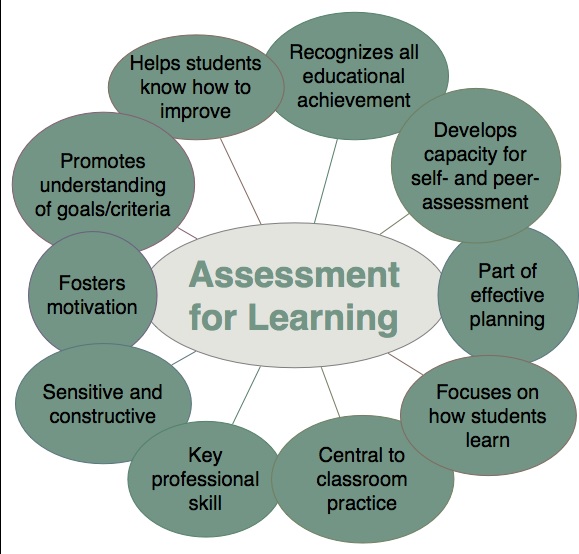
Click on graphic to enlarge
Assessment Strategies

- What is Assessment?
- Assessment Benefits & Practices
- Performance Based Assessment
- Rubrics -What is it?
- Extend Your Learning
What is Assessment?
- Assessment occurs all day long.
- Assessment drives instruction.
- Assessment engages both learners and teachers.
Assessment is more than a final exam or presentation, it involves the process of gathering information from a variety of sources (including assignments, day-to-day observations, conversations or conferences, demonstrations, projects, performances, and tests) that accurately reflects how well a student is achieving the curriculum expectations in a subject/course.
Assessment plays a powerful role in 21st century teaching. Educators, across the grades and post secondary are reconsidering the way we assess student learning. We need to reevaluate, redefine, and redesign how we assess student learning especially when we consider:
The primary purpose of assessment and evaluation is to improve student learning.
Assessment Benefits & Practices
What are the Benefits of Effective Assessments?
When it comes to the benefits for students, effective assessments:
- help students to reflect upon their own learning and progress: understand and appreciate their strengths, abilities and areas for development
- helps prevent student underachievement (teachers and students make the necessary modifications and adjustments before it is too late)
- improve motivation and self-esteem this is an important one -(students receive ongoing feedback)
- provides relevant and timely feedback – what is the point of receiving feedback at the end or close to the end of a semester (and then find out one is really not doing well, not understanding the material taught)
- helps students to set realistic targets
What Does a Good Assessment Look Like?
A good place to begin thinking about assessment practices is to consider what the benefits are to each: the teachers and students. Effective assessment enables you, as a teacher to:
- know what needs to be modified and adjusted in ones’ teaching
- determine the appropriate level, depth and pace of work you need to consider so you can really meet the needs of your students
- reflect on the quality of your own teaching
- assess and identify students’ learning strengths and needs
What are 21st Century Assessment Practices?
Different techniques of assessment have become a hallmark of 21st century assessment practices. While the type of assessment you choose depends on what you want the assessment to achieve and evaluate, here is what you need to consider to make your assessments effective. They should be:
- ongoing, using a variety of assessment methods (remember students do not ever learn in exactly the same way) that is why it is so important to take into
- take account student different learning styles
- involve students and take their opinions into account (we often hear about students not being engaged enough – this is definitely an important strategy to use to engage students.
- part of a collaborative process, if you teach alone – try and find out who else teaches a similar course or subject and share – share information, share assessment strategies, ideas.
- encompassing different ways to demonstrate task mastery – speaking, writing, and performing.
To learn more check out:
- What is the Impact of our Changing World on Assessment? (PDF)
- Assessment for Learning – Assessment as Learning (PDF)
- What are Formative and Summative Assessments? (PDF)
- Beyond Quizzes and Exams (PDF)
Performance Based Assessment
What is performance-based assessment? and How is it useful?
In the act of learning, people obtain content knowledge, acquire skills, and develop work habits—and practice the application of all three to “real world” situations. Performance-based learning and assessment represent a set of strategies for the acquisition and application of knowledge, skills, and work habits through the performance of tasks that are meaningful and engaging to students.
To learn more check out:
- Performance-based Learning and Assessment: Balance in Literacy (PDF)
- What is a Performance Task? (PDF)
Rubrics – What is it?
Rubrics are scoring tools built on graduated scales for each of the various, measurable subtasks or behaviors that really count in a student project, assignment, presentation or written paper. Rubrics unravel the mysteries of grading by laying out the specific criteria clearly and objectively. It provides students with clear markers on what the expectations are in terms of the product being produced. In a multimedia project, for example, students may be assessed on their use of media to convey a message, as well as the depth of the research, thesis statement, evidence to support their thesis, conclusion and grammar and spelling.
Involve Students in Designing the Rubric. Both teachers and students benefit by designing rubrics together. Get student input as this also engages student participation in the project or presentation. For example, assume the students have been asked to write a persuasive essay. The teacher has thoroughly explained what the persuasive paper should involve. The focus can then be directed towards the student, asking them questions, such as:
- What evidence do you think should be evaluated?
- What would the paper need to award a give you an excellent grade? or a weak grade?
Here is a general rubric for peer evaluation – Peer Evaluation (Word doc). This rubric could be adapted for use in a team assessment. It is in Word format so that you can download it and adapt it
To learn more check out: 4 Reasons to Use Rubrics (PDF)
Extend Your Learning
- The Best Value in Formative Assessment (ASCD Association for Supervision and Curriculum Development article) Ready-made benchmark tests cannot substitute for day-to-day formative assessment conducted by assessment-literate teachers.
- Why Do I Like Assessment? Let Me Count the Ways (Assessment Strategies) Good-quality assessment simply asks about our goals, our instructional procedures, and the link between both of those and learning.
- Assessment Crisis: The Absence Of Assessment FOR Learning (ASCD Association for Supervision and Curriculum Development article) While this article is written from an American perspective, what the author has to share is equally relevant for Canadian teachers. It provides more in depth information about assessment, the importance of, and assessment practices that reflect today’s needs.
- Learning Assessment & Course Alignment
Alignment is the connection between learning objectives, learning activities and assessment.